

Student's Choice: Aero Glass
- Nov 21, 2017
- 2 min read
This week I will be reviewing group 28/Glenn Mascarenhas's choice presentation on Aero Glass.

To me, this technology looks like it came straight from a video game. I think that being able to view information such as speed, relative location, and even flight/landing guidelines while in flight would be practical especially for new pilots. Learning how to fly could become much safer and possibly more efficient with the integration of AR into flight.
I remember playing games that simulated flight and usually the screen showed your relative angle to the ground as to not confuse or make the player dizzy. In a lot of games, it also showed other information like ammo and enemy targets, and, like in most first person shooter games, it showed the players location on a map.

Screenshot from H.A.W.X.
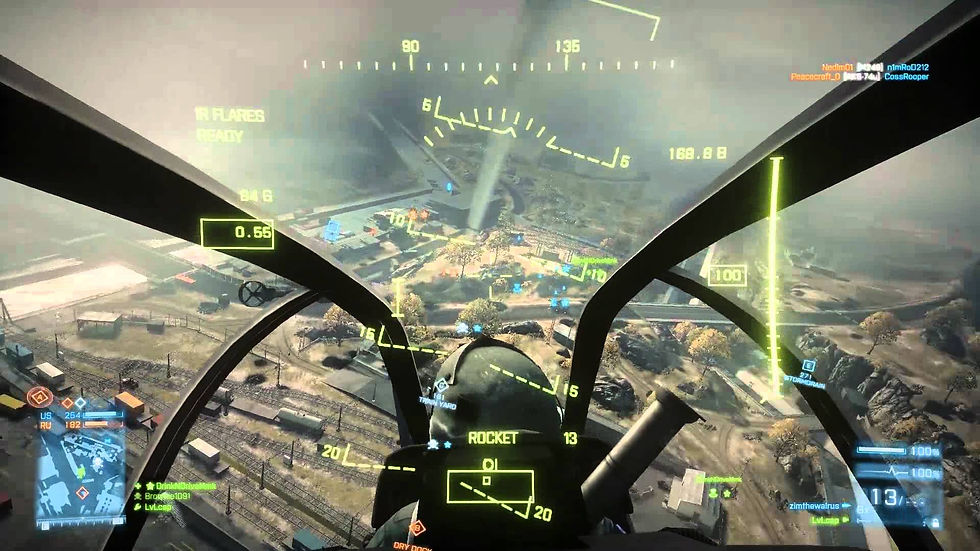
Screenshot from Battlefield 3
These markings on the screen helped the player navigate a plane using the controls on a controller or keyboard by kind of 'grounding' the player. It made it easier to visualize where they were going and what was happening on the screen in correlation to what they were doing with the controller. Translating this to reality, the same kind of information could be displayed onto the real landscape/sky space to tell the pilot where they are in relation to the ground and even in relation to storm clouds and areas of turbulence. This way, pilots can avoid potential problems and even provide a smoother flight for their passengers. Another application for this technology, as said in Glenn's presentation, is easier navigation during the night or during times where visibility is limited. Because planes use radars to detect their location in the world, the ground and areal space can be visualized during the night or when passing through a large cloud.
This is not yet a perfect technology. There are lots of issues with the reliability of a product like this because this involves the pilot to trust software in navigating aircraft, whether commercial or not. Like driving or even walking using GPS, it might not always be accurate, thus being more of a distraction to rather than actually helping the pilot. With time, as accuracy improves, I could see this type of technology becoming a normal part of flight.
Comments